
EPR Registration Procedure & Guidance Documents Support
Equal Consultancy (BIS ECS India) provides complete procedural advisory and technical guidance for Extended Producer Responsibility (EPR) registration across India. We deliver turnkey support for Producers, Importers, and Brand Owners (PIBOs) navigating centralized Central Pollution Control Board (CPCB) portals across EPR plastic- packaging waste, EPR ewaste- hardware, EPR battery- cells, and EPR oil recycling streams, ensuring fast certificate issuance, ICEGATE customs endorsement, and audit-proof credit fulfillment.
Comprehensive EPR Framework Across Core Waste Streams
Under statutory environmental mandates notified by the Ministry of Environment, Forest and Climate Change (MoEF&CC) and enforced by the Central Pollution Control Board (CPCB), Extended Producer Responsibility (EPR) is a mandatory obligation holding commercial enterprises responsible for the end-of-life collection, recycling, and environmentally sound processing of products introduced into Indian markets.
EPR applies to domestic manufacturers, international brand owners, and direct commercial importers. Under current customs guidelines, Indian Customs (ICEGATE) enforces mandatory reporting of valid CPCB registration numbers across maritime and air cargo clearance points. Failure to register results in port cargo detention, heavy demurrage, and statutory Environmental Compensation (EC) fines.
1. Plastic Packaging Waste (PWM Rules)
Covers Category I (Rigid), Category II (Flexible single/multi-layer), Category III (Multi-layer with barriers), and Category IV (Compostable). Imposes strict minimum recycled content and end-of-life recycling obligations.
EPR plastic- Portal2. E-Waste Management Rules
Mandatory for manufacturers and importers of Electrical and Electronic Equipment (EEE) across IT hardware, telecommunications, consumer electronics, and solar PV modules to fulfill annual recycling certificates.
EPR ewaste- Portal3. Battery Waste Management Rules (BWMR)
Encompasses Electric Vehicle (EV) traction packs, portable rechargeable cells, industrial power backup batteries, and automotive lead-acid accumulators with stringent material recovery targets.
EPR battery- Portal4. Used Oil & Waste Oil EPR Framework
Regulates base oil and lubricating oil producers, importers, and industrial re-refiners to establish a circular economy and ensure certified re-refining into high-grade base oils.
EPR oil PortalEPR Compliance Portals & Dedicated Service Hubs
Explore our dedicated compliance guides and portal filing support for specific regulatory waste streams. Use these back links to access specialized checklists, mass balance sheets, and registration steps:
End-to-end procedural support for plastic packaging Categories I–IV, recycled content auditing, and CPCB portal filings.
Comprehensive registration roadmap for EV traction packs, industrial storage batteries, and portable rechargeable cells under BWMR.
Statutory authorization for IT hardware, solar PV modules, and consumer electronics with certified recycling credits.
Registration support for virgin base oil importers, lubricant manufacturers, and re-refiner recycling credit coordination.
Distinct Registration Procedures by Waste Category
While all EPR registrations are facilitated through dedicated CPCB digital portals, each waste category demands distinct technical calculations, documentation schedules, and compliance targets:
A. Plastic Packaging Waste EPR Registration Procedure
Governed by the Plastic Waste Management (PWM) Rules, 2016 (as amended). PIBOs must establish their baseline by quantifying post-consumer plastic footprints introduced into each Indian state:
- Category Classification: Classify products across Categories I to IV and identify whether the enterprise qualifies as a Producer, Importer, or Brand Owner under EPR plastic- guidelines.
- Pre-Registration Mass Balance: Calculate preceding financial years' plastic consumption data broken down by polymer type (PET, HDPE, LDPE, PP, multilayer laminates).
- CPCB Portal Application: Submit registration on the centralized CPCB Plastic EPR portal with Class-3 Digital Signature Certificate (DSC), audited invoices, and state distribution blueprints.
- Post-Grant Obligation: Sourcing certified EPR credits from registered plastic waste processors to satisfy annual recycling targets and filing annual compliance returns.
B. E-Waste EPR Registration Procedure
Governed by the E-Waste (Management) Rules, 2022. Covers producers and importers across 100+ listed EEE categories across consumer appliances, computing gear, medical electronics, and solar panels:
- Sales History Compilation: Gather historical sales data across designated EEE codes to calculate product-specific lifespan and corresponding annual recycling targets for EPR ewaste- compliance.
- Portal Profiling: Execute online filing on the centralized CPCB E-Waste portal with product datasheets, IEC code, RoHS compliance declarations, and component flowcharts.
- Credit Procurement: Purchase digital recycling certificates generated by CPCB-authorized e-waste recyclers to offset assigned collection quotas.
C. Battery Waste (BWMR) EPR Registration Procedure
Governed by the Battery Waste Management Rules, 2022. Mandates stringent recovery quotas for critical raw materials—including lithium, nickel, cobalt, and lead:
- Battery Categorization: Segregate dry and wet cells across Portable, Automotive, Industrial, and EV batteries with gross and net chemical weight declarations under EPR battery- directives.
- Online Submission: File via the CPCB Battery EPR portal, providing manufacturing licenses or import declarations, battery chemistries, and projected market volume.
- Material Recovery Mandate: Fulfill mandatory recycling percentages through verified recyclers capable of certified elemental recovery.
D. Used Oil / Waste Oil EPR Registration Procedure
Notified under the Hazardous and Other Wastes (Management and Transboundary Movement) Amendment Rules. Enforces closed-loop recovery for base oils and lubricants:
- Producer & Importer Profiling: Any entity manufacturing base oil or importing virgin/re-refined base oils and lubricating oils must register under the EPR oil framework.
- Volume Declaration: Disclose import manifests, refining capacities, and volume of lubrication oil sold in bulk or consumer containers.
- Re-Refiner Tie-Ups: Purchase used oil recycling certificates from registered re-refiners to fulfill statutory circularity targets.
Unified Step-by-Step EPR Registration Workflow
Our environmental regulatory specialists guide your organization through an audit-proof, 5-stage registration lifecycle:
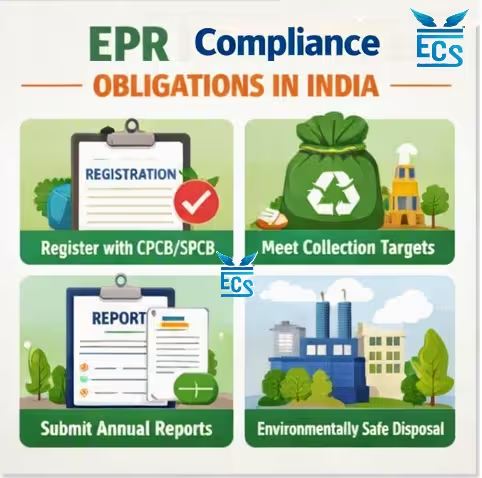
Environmental Compliance Visual Gallery
Our dedicated engineering team coordinates with CPCB headquarters, State Pollution Control Boards (SPCBs/PCCs), and authorized waste recyclers nationwide:
Guidance Documents & Mandatory Technical Checklist
To ensure zero procedural delay or application rejection on the centralized CPCB portals, the following mandatory documentation must be compiled, verified, and uploaded:
| Waste Stream | Governing Regulation | Required Documents & Technical Files | Statutory Authority |
|---|---|---|---|
| EPR plastic- Packaging | Plastic Waste Management Rules (PWM) |
• Import Export Code (IEC), GST, and PAN card • Category-wise (I–IV) weight declaration • Preceding 2–3 financial years sales invoices • Flowchart of packaging supply & state-wise distribution • Consent to Operate (CTO/CTE) for manufacturing units | CPCB (Multi-state) / SPCB (Single-state) |
| EPR ewaste- Hardware | E-Waste (Management) Rules |
• Item-wise EEE code classification & weight breakdown • Historical sales data for product lifespan calculation • RoHS conformity declaration & test summary • Authorized Signatory PAN, Aadhaar, and Board Resolution • Recycler memorandum / credit procurement agreement | CPCB Centralized Portal |
| EPR battery- Waste | Battery Waste Management Rules (BWMR) |
• Battery chemistry details (Lead-acid, Li-ion, Ni-MH) • Battery net chemical weight vs gross pack weight • Proof of domestic manufacturing or DGFT IEC for import • Material recovery target fulfillment commitment • Valid Class-3 Digital Signature Certificate (DSC) | CPCB Centralized Portal |
| EPR oil Lubricants | Hazardous & Other Wastes Rules (Used Oil EPR) |
• Base oil or lubricant chemical specification sheets • Quantity of virgin base oil produced or imported (MT) • Bill of Entry (BoE) & customs invoices for imported oil • Valid SPCB authorization for storage premises • Tie-up contract with CPCB-registered re-refiner | CPCB Used Oil EPR Wing |
Technical Guidance on Mass Balance & Recycler Credits
Accurate mass balance reporting is compulsory across all streams. EPR credit certificates can only be procured from certified recyclers or re-refiners actively registered on the respective CPCB digital portals. Our regulatory team audits third-party recycler credentials to prevent fraudulent credit cancellations during official CPCB scrutiny.
Official Guidance Documents & Regulatory Downloads
Access official regulatory guidelines, standard operating procedures (SOP), and document checklists governing EPR compliance in India:
Comprehensive standard operating procedure and document checklist for plastic packaging PIBOs.
Download EPR plastic- SOP Guide →Official CPCB guidelines for producers, importers, and recycling credit mechanisms for EEE hardware.
Download EPR ewaste- Portal Guide →Detailed technical roadmap covering EV batteries, portable cells, and material recovery targets.
Download EPR battery- SOP Guide →Regulatory circular and compliance matrix for base oil producers, importers, and re-refiners.
Download EPR oil Framework →Frequently Asked Questions on EPR Registration & Guidance
Who is required to obtain EPR Registration in India?
Any business entity qualifying as a Producer, Importer, or Brand Owner (PIBO) that introduces products with plastic packaging, electrical/electronic equipment (EEE), industrial or consumer batteries, or base/lubricating oils into India must obtain mandatory EPR registration from the Central Pollution Control Board (CPCB).
Is EPR Registration mandatory for customs clearance at Indian ports?
Yes. Central Board of Indirect Taxes and Customs (CBIC) directives mandate that importers declare a valid CPCB EPR registration number on the Bill of Entry across all Indian air cargo terminals and sea ports. Shipments lacking valid EPR authorization are placed on customs hold, leading to port detention and demurrage fees.
What is the difference between CPCB and SPCB/MPCB EPR registration?
If your business operations, packaging supply, or distribution channels span two or more states or union territories in India, you must register centrally with the CPCB. If your operations and sales are strictly confined to a single state, registration is processed through that specific State Pollution Control Board (SPCB or PCC).
How are EPR recycling targets and credits fulfilled each year?
After registration, PIBOs receive assigned annual recycling targets based on sales volumes and product lifespans. These targets are fulfilled online by purchasing digital EPR certificates (credits) directly from CPCB-registered recyclers or re-refiners and submitting annual returns via the portal ledger.
What penalties are imposed for failing to comply with EPR mandates?
Under Section 15 of the Environment (Protection) Act, 1986, non-compliant entities face steep Environmental Compensation (EC) fines, revocation of commercial import licenses, and potential legal prosecution. Payment of EC does not absolve the company from its past recycling obligations.
Why choose Equal Consultancy for EPR registration procedure support?
Equal Consultancy (BIS ECS India) offers comprehensive environmental advisory, accurate mass balance auditing, fast portal approvals, direct liaison with CPCB officers, and access to verified recycling credits across Plastic, E-Waste, Battery, and Used Oil streams.
Need Professional EPR Registration & Guidance Support?
Connect with our experienced environmental compliance specialists today. We provide end-to-end dossier preparation, portal filing, customs clearance endorsement, and certified credit fulfillment nationwide.
